
 Guide EN
 How to Pay in Brazil: The Complete Payment Guide for Tourists
· 6 min
Short answer: your credit card will work at big supermarkets and hotels, but not everywhere. Cash is a hassle to source and risky to carry. And the payment method that actually works everywhere — Pix — technically requires a Brazilian bank account you don’t have. Here’s how each option really plays out on the ground, and how to get around the Pix problem.
Does your credit card work in Brazil?
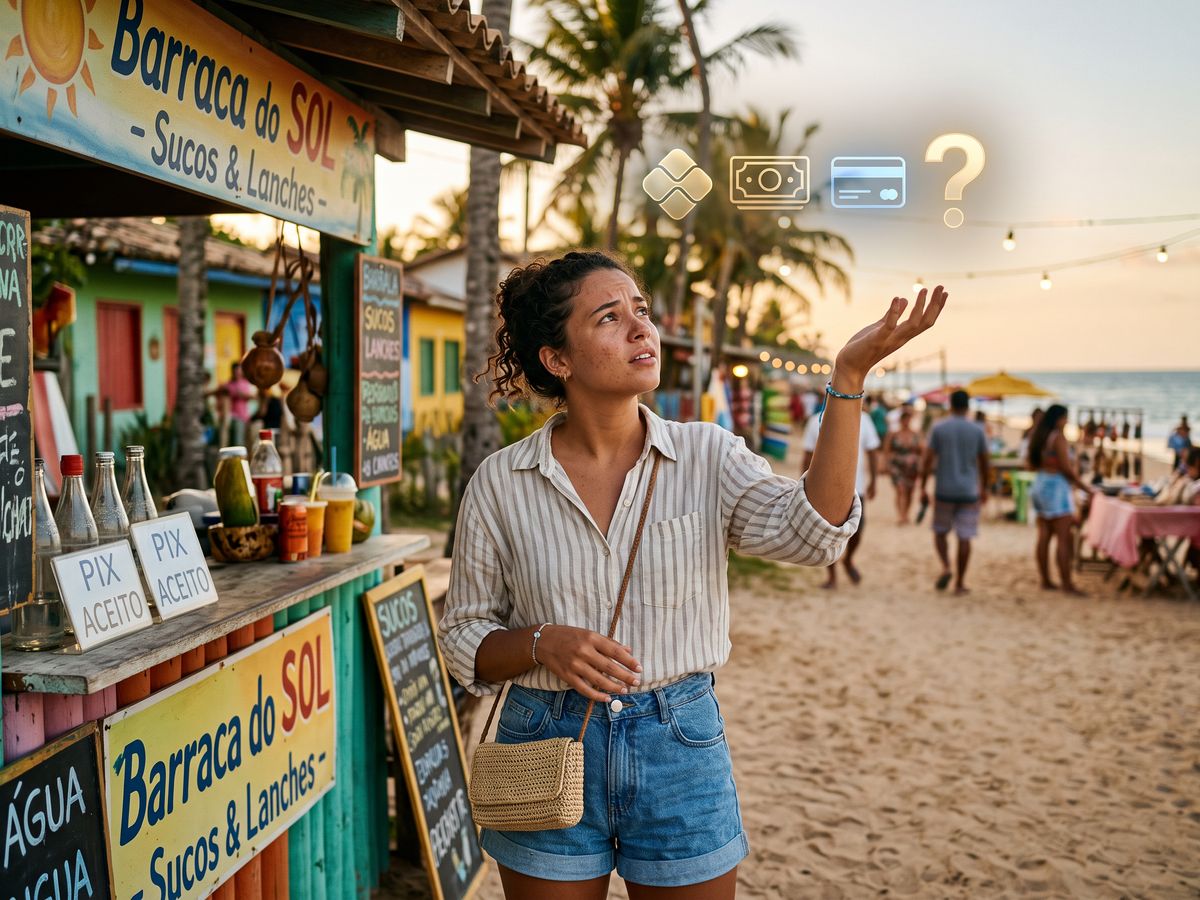
Most of the time, in big cities, large hotels, and major retailers, yes (but not 100%). For the best part of your trip — remote nature spots and beaches, small markets, the places Brazilians actually love — you’ll run into limitations. And that’s the frustrating part: you won’t know until you’re standing at the counter.
Why cards get declined at small merchants
Most small vendors — beach kiosks, market stalls, boutique shops — use local card machines (POS terminals) called “maquininhas”. These are optimized for domestic transactions. When you swipe a foreign card, the local processor and your home bank analyze the transaction — and to them, an international transaction reads as higher risk. They may simply block it without your consent.
- Fraud screening. Brazil has high card fraud rates, so acquirers and card processors apply strict fraud filters — and your own bank back home often has an even stricter risk score for Brazil specifically. The result: a chunk of legitimate transactions get auto-blocked before you even know what happened.
- Another factor, depending on your card brand: network acceptance varies. Visa and Mastercard are widely accepted. American Express is not — acceptance is low outside major hotels and malls, so don’t count on it as a backup.
Why small vendors don’t even try
A huge share of Brazil’s tourism economy runs on individual entrepreneurs — microempreendedores — who don’t carry a card terminal at all: beach vendors, kitesurf instructors, buggy drivers, massage therapists, private guides. Even when they could get a terminal, the merchant fees on international cards eat into a thin margin. Pix, by contrast, is instant and free for them to receive. So they simply ask for Pix — and only Pix.
Bottom line: your card is a solid backup for hotels, supermarkets, and chain restaurants. It’s not a plan for the informal economy, which is where most of the memorable parts of a trip to Brazil actually happen.
Should you carry cash in Brazil?
Cash always works — that’s the one thing going for it. Everything else about it is friction.
- Finding an ATM isn’t guaranteed. In beach towns and rural destinations, the nearest ATM can be an hour away from where you’re staying.
- ATM withdrawals aren’t cheap. Expect a flat fee of R$15-30 per withdrawal, plus a 3-5% FX spread, plus whatever your home bank charges on top. On a R$200 withdrawal, that adds up fast — often more than R$20-30 just to access your own money. Costs vary from bank to bank — larger banks tend to be cheaper, while the red “Banco24Horas” machines tend to be the most expensive, with withdrawal limits that can also be a problem.
- You have to plan ahead. Guessing how much cash you’ll need for a multi-day trip, then carrying it around an unfamiliar place, isn’t something most travelers are comfortable with.
- And increasingly, you don’t even need cash: Brazil is going cashless. Because of Pix, a growing number of Brazilians simply don’t carry cash anymore. Some vendors won’t have change for a large bill, and a few won’t accept cash at all.
Bottom line: cash is the old traditional fallback, not a strategy. It solves the “my card didn’t work” moment, but it introduces a new set of problems — cost, safety, and planning — that a lot of travelers would rather skip entirely. The new way is “digital cash” — Pix.
What about Pix?
Pix is Brazil’s instant payment system, and it’s not a niche option — it’s the default. It accounts for the majority of financial transactions in the country, and over 150 million Brazilian accounts can receive a Pix payment, including the entire informal economy that never installs a card machine: street vendors, instructors, drivers, small pousadas, craft markets.
Here’s the catch: Pix is usually only accessible through a Brazilian bank account connected to the Pix system. Travelers don’t have a Brazilian bank account — and opening one is bureaucratic, requiring you to be a tax resident and hold a CPF (Brazil’s tax ID).
That’s the gap that leaves travelers stuck between a card that doesn’t always work and cash that’s expensive and inconvenient to carry.
How to get Pix access as a tourist (without a CPF)
This is where Lokal closes the gap. Lokal connects to the card you already use at home — the one your salary or spending normally goes through — and lets you send real Pix payments with it. No CPF, no Brazilian bank account, no pre-loading a separate wallet.
How it works
- Download the app and sign up with just your phone and card (or Apple Pay).
- Scan a Pix QR code, enter a phone number, or use any Pix key — every payment scenario is covered.
- Confirm the amount. The fee is shown upfront, before you approve anything.
- The merchant receives the money in seconds — no pending status, no failed terminal, no awkward second attempt.
You can complete the full setup before you land, so you’re ready to pay from day one. If you’re not the plan-ahead type, you can just as easily do it at the counter, right in front of the merchant — it takes under a minute.
Verification stays light. Only once you reach a certain amount in cumulative transactions will you need a quick ID check — a passport photo and a selfie.
Card vs. cash vs. Pix via Lokal: quick comparison
Credit card
- Works everywhere? No — fails at small/informal vendors
- Setup: None
- Risk: Fraud-screening declines
Cash
- Works everywhere? Yes
- Setup: ATM hunt required
- Risk: Carrying cash in unfamiliar places
Pix via Lokal
- Works everywhere? Yes — same network Brazilians use
- Setup: Under 1 minute
- Risk: None — instant settlement, no cash on hand
FAQ
Do I need a CPF to use Pix as a tourist? No. Standard Pix requires one, but Lokal lets you make Pix payments using your own international card, without a CPF or Brazilian bank account.
Is it safe to carry cash in Brazil? It works, but it’s not the safest or cheapest option — ATM fees are high and carrying cash raises unnecessary risk, especially in areas far from your accommodation.
Why does my card get declined even though it has a Visa/Mastercard logo? Usually a mix of fraud-risk filters (from your bank or the local acquirer) and the fact that many small vendors’ machines simply aren’t built to process international cards.
Can I pay individual vendors — like a kitesurf instructor or buggy driver — who don’t take cards? Yes. That’s exactly the gap Pix (and Lokal) fills — anyone with a Pix key can receive your payment instantly, no card terminal required.
Ready before you land, useful from day one. Download Lokal and pay like a local — no CPF, no ATM hunt, no guessing what a vendor will accept.
More questions about limits, refunds, or account security? Check our full FAQ.
Write to us
Got a Brazil payment story, question, or something we missed? Any valuable tips to travel in Brazil? We'd love to hear it. Send us an email at hello@lokal-app.com.